My personal experience with this is taking around 30mg of isotretinoin for one month, and then 60mg for about 2.5 weeks. It promptly wrecked my health for the next few years and burned off a few mm of my front hairline. From personal experience, which I will detail below, I will explain elements of what is the emerging “antiretinol” or low/zero Vitamin-A coalition.
This is significant because as indicated in Personality and biometabolism or Maximum Metabolic Energy Flow, teratogens lead to significant decreases in the health of the populations and produce consequent results.
Decline in modern standards comes from a destruction of our food systems into greater unhealthy products, starting with mass production of vegetable oils in the 20s, but continuing with unbeknkownst food fortification of “fat-soluble A” in margarines.
Personal Experience and Vitamin A Rough Overview
The new view is that retinol is not a vitamin at all (something needed in small quantities for proper health/growth) and is actually a toxin. The liver stores and attempts to hold onto Vitamin A until it’s full, by which excess retinol leaks out and causes problems in the epithelial tissue. In the meantime the body is trying to excrete it through oil glands and bile. The reason isotretinoin (accutane) continues to work on acne after people finish taking it, is that the body continuously excretes it through the oil glands due to conversion of retinoic acid into other forms rather than it supposedly being not stored in the liver.
Since isotretinoin filled my liver with retinol, eating food which contains retinol causes a ‘water overflowing the cup’ effect for me, realized by the following symptoms soon after I finish eating: dry eyes, itching on arms/legs/body, burning feeling from release of retinol on face oil glands, and even urinary tract pain presumably caused by desquamation of epithelial cells. In many cases, the eating of fats such as butter/tallow leads to excretion of significant amounts of retinol-heavy bile. Without heavy fiber to bind such bile, hepatic reabsorption happens during which the process leads to the feeling of taking isotretinoin again: dry eyes, dry skin, and nightmares.
I largely believe dry eyes, eczema, but perhaps even bladder problems are caused by this extreme fortification of retinol in the modern food environment, by which after a certain age no easy resolution exists due to retinol largely being unavoidable without conscious effort in the modern food environment leading to constant overfilling of the liver stores. I logged my own elimination experiment and symptom course in this writeup.
People in this space
This was first introduced by Grant Genereux in his blog.
The Established View
For those who want the general background, the NIH handbook is fairly standard.
The Carotene Conference
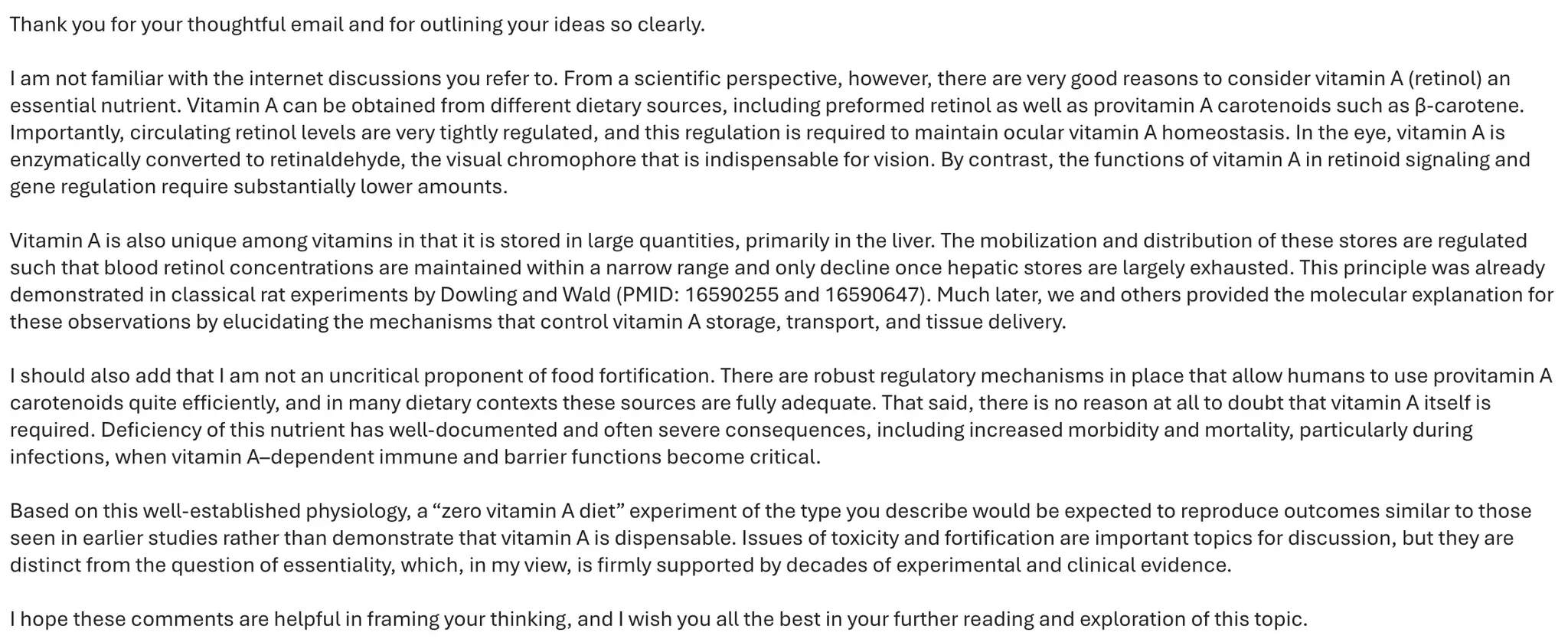
I reached out to around three researchers in the area of Vitamin A regarding the possibility of it not being a vitamin. One was actually a plant/carotene researcher, but the other two were skeptical. I received this email response from an eminent researcher in the field, which roughly aligns with the general scientific viewpoint.
The Gordon Research Conferences are well known international conferences in many scientific fields. I believe for Vitamin A/retinol, the Carotenoids conference is the main one. If you wanted to pursue this from a scientific angle, you would have to go through a research university and present at a conference. Outside of personal food choices, I believe it is unlikely any change in current fortification laws will happen outside of a nonenforcement of regulation due to institution collapse, which is unlikely.
The New Science
Note: written with AI research.
The role of retinol binding protein (RBP)
The three sources driving the low-A position — Genereux, naturopath Garrett Smith (Nutrition Detective), and supplement blogger Mike Roberto, who interviews Smith on PricePlow — form a tight, somewhat insular circle, and all three invert the textbook account of RBP. Mainstream biochemistry treats RBP4 as a carrier: hepatocytes load it with retinol, bind it to transthyretin, and ship it to tissues via membrane receptors like STRA6. The low-A camp reads RBP instead as a defensive molecule — something the body manufactures to bind and contain a toxin. Genereux pushes this furthest, claiming RBPs are effectively antibodies against retinoids; Smith puts it plainly, that the liver makes RBP “to protect the body from the ravages of Poison/Vitamin A,” and concludes you need adequate dietary protein (he cites the WHO 50g/day floor) to make enough of it. Roberto mostly evangelizes the resulting diet rather than adding theory.
The inversion borrows real findings and overextends them. Mainstream biochemistry does grant RBP a molecular protective role — binding keeps retinol soluble and shields it from degradation — but the low-A camp inflates that secondary function into the protein’s primary purpose. Their strongest empirical footing is the 2005 Nature work showing adipocyte-derived RBP4 is elevated in insulin resistance and that raising RBP4 induces it in mice; mainstream reads this as a non-canonical adipokine signaling role, the low-A camp as proof that “transport” was always a cover story. The weakest link is Genereux’s antibody argument, which rests on ELISA and Western blot being antibody-based assays. That is a category error: ELISA uses antibodies to detect a target (insulin, CRP, anything), which says nothing about whether the target is itself an antibody.
Blood levels and the testing problem
Both camps agree on the underlying physiology and split on what it means. Serum retinol is held in a narrow band (~20–60 mcg/dL) because the liver only releases retinol bound to RBP and only on peripheral demand, so blood levels stay flat across a wide range of intake and liver storage, dropping only once hepatic stores are nearly exhausted. Mainstream toxicology adds that overt toxicity appears at the other tail, when retinol exceeds RBP’s binding capacity. The low-A reading is that this homeostasis makes serum retinol blind to the problem they care about — hepatic loading. Smith’s repeated citation is a protein-deficient patient with toxic liver levels (~19,000 IU/g) whose serum retinol and RBP were both below normal and whose RBP wasn’t even retinol-saturated: loaded liver, “deficient” blood.
The same data carry a more pedestrian reading. Serum retinol is a poor instrument at both tails — uninformative across the middle, meaningful only near depletion or frank overload — which is exactly why epidemiology uses RBP as a cheap deficiency proxy and toxicology leans on intake history. RBP adds a confound both camps invoke: impaired RBP production (protein or zinc deficiency, liver disease, inflammation — RBP is a negative acute-phase reactant) can strand retinol in the liver, producing low serum retinol with adequate stores. The retinol–RBP ratio is genuinely not a clean 1:1 in inflamed or infected populations, and mainstream nutrition epidemiology has been adjusting for it — the low-A move is to treat “imperfect proxy” as “fraudulent test.” The behavioral consequence matters: distrusting serum retinol, the protocol’s aim is to drive it below the deficiency cutoff and hold it there as the only available proxy for liver depletion, accepting real functional-deficiency risk (night blindness, immune and epithelial effects below ~10 mcg/dL) on the bet that the reading is artifactual — a bet untestable short of a liver biopsy nobody will do.
Symptoms of retinol toxicity
- Itchy skin esp. on hands, arms, legs, dry eyes, burning feeling on face, urinary tract pain due to epithelial desquamation, hair loss
Comments
No comments yet — be the first.